

Small Towns in Texas Are Not Growing by Accident
Search interest in small towns in Texas has been climbing steadily, and the reason shows up clearly in the state’s own population data. Texas Demographic Center figures put domestic migration, people moving in from other states or other parts of Texas, behind roughly half of the state’s total population growth in recent years. That is not a small footnote. It means the biggest driver of who lives in Texas right now is not births, it is people actively choosing to relocate here, and increasingly they are choosing somewhere other than the biggest cities.
The state demographer’s office has described this as two different stories happening at once. Dallas, Houston, Austin, and San Antonio keep growing, but their urban cores have hit a point where housing is limited and expensive, so a lot of that growth is spilling outward into the counties around them. At the same time, small and midsized cities that sit near a regional hub, rather than isolated in the middle of nowhere, are picking up growth of their own. Truly remote rural counties, the ones with no city nearby at all, are mostly shrinking. Location relative to a real city turns out to matter more than town size by itself.
Where Bullard and Smith County Fit Into That Pattern
Smith County, home to Bullard and the city of Tyler, is a useful example of the second story rather than the first. It is not a suburb hanging off the edge of Dallas or Houston. It is its own regional hub, and the growth numbers reflect that on their own terms. The county’s population has grown by more than 21 percent since 2010, and current estimates put it above 250,000 residents, one of the faster growing counties in this part of the state.
That growth did not happen because Smith County got cheaper or because nothing else changed. It happened because Tyler offers real infrastructure, hospitals, a growing university presence, retail, while towns like Bullard just outside it still offer the land and pace that a lot of people are specifically looking for when they search small towns in Texas in the first place.
What Separates a Small Town Worth Moving To From One to Skip
Not every small town in Texas benefits from this shift. The ones that show up on best small towns in Texas lists tend to share a few things in common. A real city close enough to reach without a long drive, usually inside twenty minutes or so. Internet infrastructure that actually supports remote work rather than forcing satellite as the only option. A school district families are not settling for, but actively choosing. Towns missing any one of those tend to keep losing population even while the state around them grows.
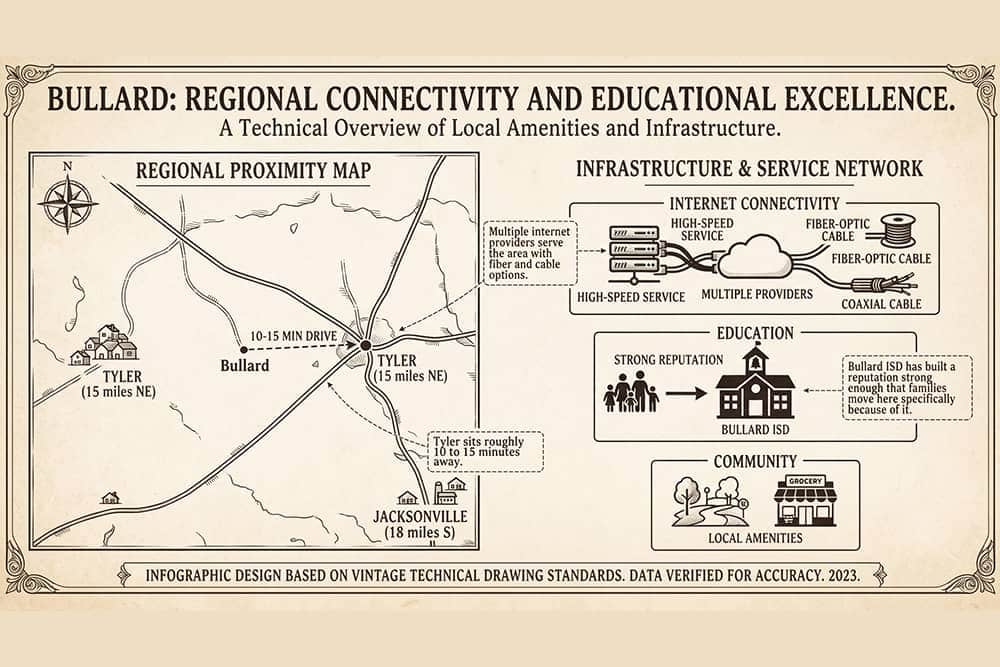
Bullard checks each of those boxes without much of a stretch. Tyler sits roughly 10 to 15 minutes away. Multiple internet providers serve the area with fiber and cable options. Bullard ISD has built a reputation strong enough that families move here specifically because of it, not despite it.
What the Move Actually Costs, Compared Honestly
A new construction home on close to an acre in a community like Wild Horse Estates Phase 2 starts around 525 thousand dollars, and that number can look high next to a city wide median home price in Dallas or Austin. The problem with that comparison is that a city median blends in every existing home on the market, including plenty of small, decades old resale homes that pull the number down. New construction is a different category entirely, and pricing it against new construction is the comparison that actually matters here.
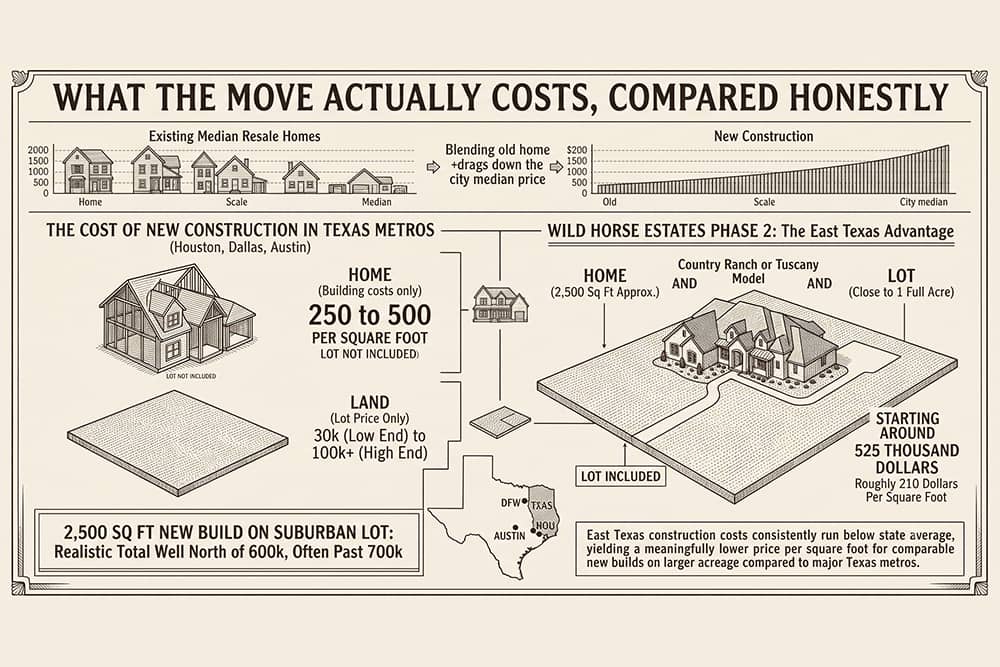
Custom and semi custom new construction in Houston, Dallas, and Austin typically runs 250 to 500 dollars per square foot once the home itself is priced, and that figure usually does not include the lot. Land alone in those metros can run anywhere from 30 thousand dollars on the low end to well over 100 thousand, and considerably more in desirable neighborhoods. Put a 2,500 square foot new build on a decent suburban lot in any of those three metros and the realistic total lands well north of 600 thousand dollars, often past 700 thousand once land and finish level are factored in.
The Country Ranch and Tuscany models in Wild Horse Estates run close to 2,500 square feet starting around 525 thousand dollars, which works out to roughly 210 dollars per square foot, with the lot already included rather than priced separately. East Texas construction costs consistently run below the state average, and that gap is exactly why a comparable new build here costs meaningfully less than the same square footage in a Dallas, Houston, or Austin suburb, even before factoring in that the lot here can run close to a full acre instead of a standard suburban footprint.
Why This Wave of Movers Looks Different Than Past Ones
People leaving Texas cities for smaller towns is not new, but who is doing it now has shifted. Remote and hybrid work removed the old requirement of living within a short commute of an office five days a week, which opened up towns like Bullard to buyers who would have had no real choice but to stay in the city a decade ago.
What has not changed is what people are unwilling to give up. Nobody relocating from Austin wants to lose access to a real hospital or a reasonable drive to an airport entirely. The small towns actually gaining residents are the ones within reach of a regional hub, not the ones genuinely isolated. Bullard sitting just outside Tyler fits that pattern directly rather than being an exception to it.
Frequently Asked Questions
What makes a small town in Texas worth moving to versus one to avoid? Proximity to a real city for healthcare and shopping, internet reliable enough for remote work, and a school district families are choosing rather than settling for. Towns missing any of those tend to struggle to hold onto residents.

Is it actually cheaper to buy in a small town near a Texas city? Compared to an existing resale home, not always. Compared to new construction of the same size in a Dallas, Houston, or Austin suburb, yes, meaningfully. New builds in those metros commonly run 250 to 500 dollars per square foot before the lot is even priced in, while a comparable new home here starts around 210 dollars per square foot with the land already included.
How much has Smith County actually grown? Smith County’s population has grown more than 21 percent since 2010 and now sits above 250,000 residents, driven mainly by people moving in rather than local births.
How far from Tyler is Bullard? About 10 to 15 minutes by car, close enough for regular errands, healthcare, or work while still keeping a genuine small town feel.
Wild Horse Estates – Phase 2
Inventory like this doesn’t sit long
in a market this size.
For current pricing, available lots, and to schedule a walkthrough, reach out directly or stop by the community.
Call to schedule a tour
Kenny Tran
714-683-3099
13046 FM Road 346 Bullard, TX 75757
Open daily: Call ahead to schedule a walkthrough
Beograd Homes builds new construction in Smith County, TX, with a focus on quality foundations, thoughtful floor plans, and transparent pricing throughout the build process.


